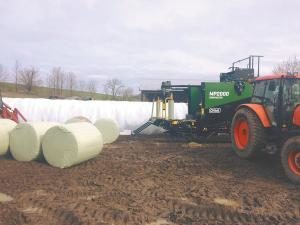
On May 10, 2019, Baled Storage was featured on SiriusXM Rural Radio on the Shark Farmer show.
Viren D’Souza talks about the Orkel Baler Compactor and some of the ideal uses and some less ideal uses courtesy of show host Rob Sharkey.
Rural Radio Podcast
A complete transcript of the interview is available here.
Featured in Farm Show Magazine
The Orkel stationary baler (Vol. 36, No. 4), now available in North America, could make corn silage as easy to package and move as big round bales. Viren D’souza, D’souza Farms Systems, is demonstrating the Norwegian-built baler to potential customers in Ontario and elsewhere. Meanwhile, he is doing custom baling with it. He thinks it could change how small producers view corn silage.
“Normally, you can’t move corn silage without feeding it within a day or so,” says D’souza. “This baler squeezes the air out, reduces the volume by at least 3 to 1, and wraps it airtight in plastic. Now you can transport it like any commodity and store it until needed.”
D’souza likes the simplicity of the machine. He notes that the company has wanted to break into the North American market, where corn silage is all about bunks and bags. With the Orkel, the silage (or other chopped material) can be dumped in by bucket loaders, compacted, wrapped and put in storage.

“Compaction is even from the first bale to the last, much better than packing a trench with a tractor,” says D’souza. “Being able to move corn silage and sell it to small producers without the equipment to make silage is huge.”
Of course the industrial strength baler isn’t limited to corn silage. While that season is only weeks long, other uses are year round. It works equally well with wood shavings, wood chips, sugar beet pulp, compost, and other waste materials. D’souza is experimenting with distillers dried grains and sees great potential for making and marketing total mixed rations.
“The real value of the Orkel is when you start baling things throughout the year,” he says. “It really shines with all types of organic matter. Squeeze the air out, wrap it and let it sit. Bulk material usually requires a walking floor or dump trailer, but bales can be shipped on flatbeds. They are less expensive and multi-purpose for return loads.”
D’souza describes baling wood shavings and letting them sit for more than a month. “When I opened the bale, they were cool and came apart easily with the hand,” he says. “There was no heating or other problems. Fermenting only lasts until the air runs out.”
D’souza also likes the Orkel for its ease of maintenance and operation. He points to automatically greased bushings instead of bearings in the compaction chamber and simple hydraulic-driven apron chains and other components.
“They are running all over the world with operators of all levels of skills and education,” says D’souza. “That says a lot about how robust they are.”
The Orkel baler is priced at $350,000 (Canadian) or about $275,000 U.S.
Contact: FARM SHOW Followup, D’souza Farms Systems, P.O. Box 160, Keene, Ont. Canada K0L 2G0 (ph 613 532-6455; virendsouza@gmail.com; www.baledstorage.com).
To watch the full story on Global News, Click here
According to the Peterborough County Federation of Agriculture, Canada is one of the world’s leaders in agricultural innovation.
That includes creative land use, as well as the technology used on the land.
Harley Farms, in Keene, Ont., about 17 kilometers south of Peterborough, has a form of creative land use by farming on a seven-year rotation. Co-owner Roger Harley says the crops, such as red clover, fix nitrogen back into the soil.
“Our field has had no sprays, no fertilizer at all. It’s just pure, 100 per cent naturally grown red clover,” he said.
Harley Farms also has several types of livestock which are kept outside year-round.
But this seven-year rotation didn’t grow overnight. Since the Harley family moved from England to Canada 18 years ago, it’s been working to get the growth rotation right.
Harley says it’s important to him to be 100 per cent chemical free.
“We run our farms but at the end of the day, do we have the right to pollute the next-door neighbours’ water course with chemicals we put on our fields? I don’t think so,” he adds.
“I don’t think we have the right to pollute the Great Lakes. But until somebody comes up with another option for these farmers who are using chemicals and sprays — and getting rid of their hog manure by liquid tanks and spraying it all over the field — those things are going to run off, and get into our water supply. They’re gonna get into the food supplies.”
These days, farmers also need to find multiple ways to sustain their business, Harley says.
His son James co-owns the farm. He and his sister have focused on expanding the farm’s agri-tourism potential: Adding activities or features that brings visitors to a farm.
“We’ve started doing a lot of farm tours, and different events on the farm,” James said. “We do a cross-country skating trail in the winter, and just this past spring we did an event with our lambing.”
Technology on the farm is also changing.
Paul Glenn, president of the Peterborough County Federation of Agriculture, says to compete in the global market, Canada needs to create new ways to produce food. That means staying updated with technology.
“Like my combine, it’s the new diesel technology, so it’s very clean,” he said. “It’s basically the same production value of two combines that I used to have. So now I’m doing two times the amount with two thirds of the fuel.”
As originally printed in Peterborough This Week

KEENE — Viren D’Souza knows his way around the fields and barns of Peterborough County’s farm country well, but none are his.
The Keene resident makes his living fixing robotic milking equipment on dairy farms — a career he built for himself when he had trouble finding work after college. Now, nearly a decade later, he’s as much a part of the area’s agriculture sector as the farmers he works with. And while he doesn’t have any crops to worry about during harvest season, or any animals to turn out to pasture, Mr. D’Souza makes his living from the industry all the same and he’s just as passionate about its future.
Unlike many of his peers, it’s not a passion that was handed down to him — it was one he found and fostered himself.
Mr. D’Souza was born in Kuwait and emigrated to Canada with his family as a child. He ended up working with his father at the Keene General Store, which happens to serve one of Peterborough County’s farming communities.
“Through the store, I knew a few customers who had farms,” he says. “I thought I would try something different and I went and helped them out a little bit.”
When it was time to start thinking about a career path, Mr. D’Souza says crop prices were down and the farming industry was in a lull, so he applied to become a police officer.
As fate would have it, he didn’t pass the physical test.
Not knowing whether he would give the test a second run after a six-month waiting period, he headed to New Zealand, where he once again gravitated to the farming community. He drove tractors, milked cows and learned how to shear sheep — a skill that still earns him some side jobs when he has the time.
“It was the hardest course of my life,” he says. “I had muscles aching that I didn’t even know I had.”
In order to shear a sheep, you have to hold a sheep in place by their legs — with the idea being that the way you hold the sheep is supposed to help it relax, although that’s not always the case.
“In the beginning you’re using your muscles,” he says. “When you know what you’re doing, you’re using finesse.”
Back home, he enrolled in college, first taking television broadcasting. He volunteered in the industry and couldn’t find any promising job prospects.
He went back and enrolled in an electrical program, but that didn’t turn up any jobs either.
“I had a hard time finding a job in that field because it was very much who you knew,” he says.
Instead of heading back to college for a third time, Mr. D’Souza started making some calls to milking equipment dealers, thinking it could be the perfect way to mesh his farming and technical experience. He landed a job with a dealer in Prince Edward County, and the rest, as they say, is history.
The job saw him travel and work on farms from Hastings to Kingston. A few years later, when the company sold, he became a free agent.
“I learned that if you know what you’re doing, it’s not hard to find work,” he says. “Somebody once called me a soldier of fortune in the milking industry.”
Over time, Mr. D’Souza says the electrical component of his job has become about 10 to 15 per cent of the skill set that’s required to do his job.
“You also have to be thinking about the mechanical side of it, about animal health issues, about cleaning the system — because sometimes that’s what the problem is,” he says. “Being able to problem solve is probably more important that what you took in college.”
He has helped install and repair milking systems on farms from the Ottawa Valley to Moose Jaw, Saskatchewan, giving him a first-hand look at how the Canadian agriculture sector works.
With contacts across the country, Mr. D’Souza keeps his ear to the ground on issues affecting the industry, and through social media, he’s become a voice for the dairy sector, sharing farmers’ concerns and successes.
“Farming has a good story to tell,” he says. “And I enjoy telling it.”
Given his experience and passion, Peterborough Agricultural Society president Ryan Moore says Mr. D’Souza is an asset to the area’s farming community.
“I call him an encyclopedia of agriculture,” he says with a laugh. “He seems to know a little about everything.”
Mr. Moore says it’s not often he comes across people who are genuinely interested in agriculture, without owning a farm.
“He has something to contribute to the conversation,” he says. “And that’s pretty hard to find.”
Mr. Moore is the midst of trying to convince Mr. D’Souza to join the agricultural society’s board of directors.
He says the lack of agri-education available to the community is one of the farming community’s top concerns and priorities — it’s an issue Mr. D’Souza agrees needs some attention.
“It’s about people not really knowing where they’re food comes from,” he says. “And (Mr. D’Souza) gets that.”
This year, Mr. D’Souza worked with a handful of others as part of the Fearless Marketing Team to help promote and publicize the Peterborough Exhibition.
Mr. D’Souza says he’s looking forward to seeing how the annual event can become even bigger next year.
In the meantime, Mr. D’Souza says he plans on continuing his work on dairy farms, as well as any other farming jobs that come his way.
“I still don’t know what I’m going to do when I grow up,” he says. “We’ll see what happens.”
Viren D’Souza was featured on an episode of Ontario AgCast.
Click here to listen in.